Return of the Prodigal Son by Pompeo Batoni - 1773

Evolution for the Catholic Student

Order 'Evolution for the Catholic Student' - Click on the image above


Wednesday, November 13, 2013

Force Obama's Hand

Force Obama's Hand
 

“Under my plan, if you like your current health insurance, you can keep it.”  These words were spoken by Barack Obama when he was selling Obamacare to the American people, and they are not true. 

Since Obamacare began taking effect, millions of Americans have received cancellation notices from their health insurance companies.  Usually this is because the plans that people have, and like, do not conform to Obamacare mandates.

People are rightly very angry.  Obama is getting pressure from Republicans and Democrats to do something about it.  And we have been assured by his spokesman Jay Carney that he will.  One thing he will not do, however, is simply let people keep their current plans, even if they want to, if those plans don’t comply with his mandates.

Congress, however, is trying to force the issue.  A bill called the Keep Your Health Plan Act is being voted on Friday in the House, which will allow people to do what Mr. Obama promised they would be able to do.  Former President Bill Clinton has endorsed such a plan and Democratic Senator Diane Feinstein is co-sponsoring a Senate version of the bill.

It is imperative that we pressure our representatives to pass this bill, and by a large margin.  If nothing else, we should force Obama to stand up before an angry public and veto a bill that simply seeks to make him keep a promise he repeatedly and forcefully made.

Hopefully the bill will garner enough support to override a veto.  The American people deserve it, and Mr. Obama needs to be taught a lesson about the value of a promise.

Note:  Although I believe these cancellations are a violation of Mr. Obama’s promise, at least as most people interpret it, in fairness I should state his position that grandfathers in plans in existence when the law was passed in 2010.  Any plans that have been created or changed from that time until now, as the law takes effect, from his perspective, can be cancelled without violating his promise.

Tuesday, November 12, 2013

The Catholic Roots of Thanksgiving


The Catholic Roots of Thanksgiving


Image from http://happyheartsmom.typepad.com/sweetness_and_light/hearth_and_home/

In just a couple of weeks we will be celebrating Thanksgiving.  Most people know the history of the holiday, from the first Thanksgiving celebration with the Pilgrims and American Indians, to its official proclamation as a national holiday by President Abraham Lincoln in 1863.

But many people don’t know that our modern holiday of Thanksgiving actually has roots firmly planted in Catholic history.  Besides Veterans Day, November 11 is also the feast day of St. Martin of Tours.  Martin was a fourth century pagan soldier who once saw a poor beggar freezing in the cold.  He cut his own heavy cloak (meant to keep himself warm) in half and gave half to the beggar.  That night he had a vision of Christ Himself wearing the cloak.  Martin left the army, converted his family, and moved to Gaul to live a monastic life, where he was eventually made the bishop of Tours.

In medieval Europe it was customary to celebrate St. Martin’s feast day by having a Thanksgiving feast, thanking God for the harvest.  This custom survived in Protestant communities even after the time of the Reformation, and was one the Pilgrims brought with them to the New World.

So it is not surprising that they chose to offer thanks with their Native American friends that first Thanksgiving with a feast similar to that which they held back home.

There have been a few minor changes, of course, the most obvious of which is the date.  Also, the Thanksgiving feast celebrated on Martinmas featured goose as the customary main dish.  The Pilgrims did in fact celebrate that first Thanksgiving with goose, along with some of the abundant wild turkey they had hunted.  In America, of course, the turkey has wrestled control of the holiday away from the goose (not that many geese are likely to complain).

So as we prepare for Thanksgiving this year, it is nice to remember that it truly is a Catholic holiday, and perhaps we can ask the prayers of St. Martin, without whom we may never have had this annual over-stuffed, football-frenzied day of grace.

Sunday, November 10, 2013

Happy Veterans Day

Happy Veterans Day

      Thank you for your service.  May God guide and protect you.

Thursday, November 7, 2013

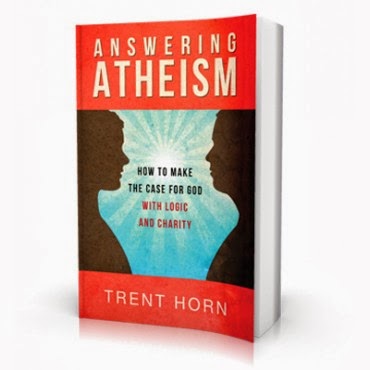
Book Review - 'Answering Atheism'

Book Review – Answering Atheism
http://shop.catholic.com/answering-atheism.html
 

Trent Horn has been studying the phenomenon of atheism for years.  In his new book, Answering Atheism, published by Catholic Answers Press, he makes a clear and charitable response.

The book is broken into three parts.  The first clarifies the terms and positions in the debate.  He also analyzes its tone in recent years, and promises that his work will not sink to the level of insults and name-calling.  In reading the rest of the book, one finds that he keeps his word.

The second part of the book analyzes and critiques the arguments for atheism.  Often we find that in talking to atheists, they will debate our positions for theism and see atheism as a default position.  It is as if atheism is the starting point and as long as there is any conceivable answer to our points (reasonable or not), then atheism must be assumed.

But of course this position is unreasonable.  An atheist should be able to give clear reasons for being an atheist.  Horn looks at the most common reasons in this section of the book, most notably the ideas that the concept of God is a logical contradiction, and that the existence of God is incompatible with the existence of suffering and evil.  Horn very thoroughly and fairly presents the atheist arguments, and very charitably and completely shows them to be false.

The third and longest part of the book includes the reasons to believe in God (theism).  Horn is not specifically an apologist for Christianity in this work, although there are a few points at which he shows that the Christian conception of God makes the most sense out of reality.

Horn delves into the recent advances in physics that prove the universe (space-time) had a beginning, before which there was nothing.  And, of course, something can not come from nothing.  He looks at the improbable fine-tuning of our universe that makes it capable of supporting life.  Finally, he puts forth the moral arguments for the existence of God and takes a look at personal experience.

In the spirit of Thomas Aquinas, Horn gives voice to every possible objection to his arguments.  Much of the book, in fact, is spent answering these challenges.  The result is that when the reader is finished, it is very likely he will have any points of disagreement left untreated.

My criticisms of this book are few.  The first was touched on earlier this week in my article about evolutionism.  The only other thing to watch out for is that because Horn goes through so many difficulties people might have with his arguments, at times the main point can get lost in the technicalities.

This technique, I’m sure, is very helpful to the skeptical reader and he does well by leaving some of the more far-fetched objections to the appendices, allowing the main text to flow more smoothly.

Overall, Answering Atheism is a worthy book to add to one’s library.  It is intellectual but not difficult to read.  It can also serve as a powerful reference tool when challenged by an atheistic argument whose answer is not readily on the tip of the tongue. 

Wednesday, November 6, 2013

Link - Journey to Manhood

Link - Journey to Manhood

     At the following link is the incredible story of Walt Heyer, whose struggles with gender identity led him to live for years as "Laura."  Calling his decision to live as a woman "the biggest mistake of his life," Walt courageously shares his story to help other people struggling like he did.

http://www.lifesitenews.com/news/journey-to-manhood-a-former-transsexual-tells-his-story/

Monday, November 4, 2013

Christian Evolutionism in Apologetics


Christian Evolutionism in Apologetics

At the outset, I must acknowledge that the Theory of Evolution (macro-evolution as envisioned by Charles Darwin) does nothing to disprove the existence of God.  Most would argue that it does not disprove Christianity.  The Catholic Church, in fact, has said that Catholics have the freedom to believe in it, provided they acknowledge God as the Creator, the direct creation of our souls by God, and certain truths about our first parents (among the other principles of the Faith).

          Given all that, I was unsure about whether to even write this post.  And it is understandable why many apologists don’t bother touching on evolution.  Trent Horn, in his book Answering Atheism, recounts a debate between theists and atheists on a college campus at which he noticed that the atheist literature was exclusively about evolution.

          Given that evolutionism essentially misses the point, and is frequently used to advance straw man arguments, isn’t discussing it playing into our opponents’ hands?  Most of the time, it probably is.

          However, there is one pet peeve of mine (of which Mr. Horn is guilty despite the quality of his book) that I do think is a mistake.  That is the uncritical acceptance of evolution within arguments for theism.  Modern apologists apply the highest standards of scientific rigor to our arguments supporting the existence of God.  We want no stone left unturned in order to display beyond any doubt where the evidence leads.

          When it comes to evolution, however, there are often no critical standards applied at all.  Again, I understand the reasoning.  It does us no good to get bogged down over theories that are essentially irrelevant to our purposes.  And given the success atheist professors have had turning young people away from faith using evolutionism, it would seem that taking the sword out of our enemy’s hand would be quite wise.

          My only concern is this: by setting such a standard (or really a lack of standards), we are giving uncritical credibility to a belief system that hasn’t earned it.

          This is why, despite the theological differences I may have with him, I appreciate the recent documentary by Ray Comfort, Evolution vs. God.  In it, he asks professors at top universities for one piece of observable evidence for Darwinian macro-evolution, and he gets none.  There are a few examples of micro-evolution, such as certain fish, or Darwin’s finches.  Horn gives the impressive example of bacteria that have developed the ability to metabolize harsh acids.  (It is important to note that though this ability was designed over 50,000 generations of bacteria by the intelligence of scientist Richard Lenski, the bacteria never began to become anything other than bacteria.)

          All of these examples show adaptability, and impressive foresight in creation.  These are forms of micro-evolution and are certainly not Earth shattering.  The many breeds of dog, for example, are thought by virtually all creationists to have come from a few on Noah’s ark.  And we have heard of antibiotic-resistant bacteria for years.

          But in none of these examples did the birds, fish or bacteria become something else entirely (what are often called different “kinds”).  When the professors were asked to confirm that none of these creatures actually gave rise to any other type of creature, they responded, “Well, of course not,” even though that is exactly what Darwinian evolution would suggest.

          But we have to imagine these small principles put into effect over millions of years.  Then these small changes, applied to single-cell organisms at the start, could give rise to the massive diversity we see around us today, right?  I would argue that they could not.  There are many good, scholarly works out there that explain exactly why they could not, and I could not do them justice.  They are not hard to find.
          My point is that there are scientific standards that the Theory of Evolution can not meet.  We are still free to believe in it, but no one should blindly accept it as truth.  And though it is not at the heart of apologetics and is probably most often best left on the shelf, I think we need to be careful about setting a bad example in that regard.

Wednesday, October 30, 2013

The Mystery of Atheism


The Mystery of Atheism

I have worked with young people for many years in Catholic settings.  The biggest tragedy for me is when I hear that one of them has, somewhere down the line, decided that he or she is an atheist.  I have become very conscious of that and often try to subtly plant the answer to atheist arguments years before my students are ever likely to face them.  (Of course, the strongest argument against atheism is a relationship with Jesus Christ.  Regardless of the arguments presented, no one could convince me that my mother does not exist.  I personally know her.)

With atheism seemingly all the rage these days, it has had me wondering what causes people to embrace it.  There are many factors, and some could argue it is “in vogue,” as once eugenics, racism and disco have been.  But clearly there’s more to it than just that.  Atheism is a response to the most basic of human questions, and it is a tragic one.  What leads people there?

It seems to me there are three main categories of reasons people become atheists.  Bear in mind I am not a professional sociologist, theologian, or expert on this issue in any sense of the word.  However, perhaps there is something worthwhile in my musings.

The first category contains the intellectual atheist.  This person has intellectual arguments against the existence of God.  Very often he has come across some “science” that he feels disproves an important aspect of the Christian faith as he understands it.  Therefore, he believes, atheism is true.

This is, in my opinion, the easiest type of atheism to “cure,” because all it requires is education.  The evidence (scientific, historical, philosophical, etc.) all points clearly to the existence of God.  Very often this type of atheist has become a disciple of evolutionism.  Forgetting for a moment the weaknesses in the theory of evolution, the Church has allowed that it can be compatible with Christian faith, and it certainly does nothing to suggest simply that a transcendent Creator does not exist.

Of course, I think the purely intellectual atheist is very rare.  If someone’s lack of Faith is based solely on intellectual grounds, he’s much more likely to be an agnostic.  If he doesn’t think the evidences for the existence of God are impressive, he certainly can’t be impressed by the evidences for atheism, since there essentially are none.  The best atheism generally does is debate the motives of credibility for Faith; it rarely produces positive arguments for itself.

The second type of atheist is the emotional atheist.  I think this is actually the most common.  This is a person who has experienced an intense suffering, or is just very sensitive to the suffering of others, and can not reconcile that to the existence of an all-powerful and all-loving God.

There are certainly many answers to this objection, and much has been written about suffering from a Christian perspective (see On the Christian Meaning of Human Suffering).  But I think the first thing we need to do is show this person compassion.  Can he or she see in us the Face of the God who not only suffers with us, but suffered for us?  If we can somehow bring Christ’s peace and love to these people, perhaps their hearts will open to the answers to their questions about suffering, and to a relationship with the One who can heal them.

Finally, there are those who are atheists for moral reasons.  Living in a culture that promotes anti-Christian values, many people find themselves attached to or habituated with behaviors that they know are inconsistent with belief in an all-holy God.  The response often is to build their belief system around their behaviors, rather than the other way around.  We have all been guilty of this to a point.  It’s called rationalization, and when taken to the extreme of atheism, can sometimes lead to very angry people, and the accusation that “people of Faith are all judgmental and hypocrites, so why would I want to be one of them anyway?”

Unfortunately I haven’t found the answers to all these problems.  Trent Horn has done his best to present them, though, in his new book Answering Atheism, which I intend to review next week.  My point in this article is that if we are close to someone who has identified him or herself as an atheist, the first thing we may need to do is find out what is at the root of that atheism, as our approach may vary depending on what it is.

Of course, one thing that shouldn’t vary is our witness of a Christian life that is authentic, loving and joyful.  It is hard for anyone to argue forever with that.

Note: If an atheist should stumble across this post who can not see himself as falling in any of the three categories I mentioned, please email me at servantofcharity@yahoo.com, as I would be very interested.  Please note if you would prefer I not publish what you write.