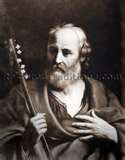
Return of the Prodigal Son by Pompeo Batoni - 1773

Evolution for the Catholic Student

Order 'Evolution for the Catholic Student' - Click on the image above


Monday, March 19, 2012

Becket Fund for Religious Liberty - Myth #2

Becket Fund for Religious Liberty –
Myth #2

The mainstream media have been working overtime to try and dupe the American people that the war the President has declared on the Church through the HHS mandate is about anything than an out-of-control government violating the religious liberty and conscience rights of its citizens.  The Becket Fund for Religious Liberty is debunking some of the myths being spread through a series of short videos.  Here is the response to Myth #2: Federal funds mean the feds make the rules.

Sunday, March 18, 2012

The Feast of St. Joseph

The Feast of St. Joseph

          My three sons are named after St. Damien of Molokai, St. Dominic and St. Maximilian Kolbe.  Those three men lived quite extraordinary lives.  Damien voluntarily spent the last two decades of his life living in a leper colony and ministering to those dying from that dreaded disease.  Predictably, he contracted leprosy himself and offered his life as a sacrifice to Christ.  St. Dominic traveled all over preaching the Faith against the Albigensian heresy.  He won many souls back to the Church because of the fidelity of his life to his teaching.  St. Maximilian Kolbe established the Knights of the Immaculata, was one of the first to use the mass media for the spread of the Faith, and voluntarily died in another man’s place in a Nazi concentration camp.
          Today (March 19) is the feast day of St. Joseph, whose life, to undiscerning eyes might seem less remarkable than those of these three great saints.  But to us he is among the greatest of the saints.  He is the man specifically chosen by God to be the foster father of His Son and the spouse of His Mother. 
          The Scriptures and even Tradition tell us very few of the details of the life of St. Joseph.  He, of course, brought Mary to Bethlehem for Caesar’s census, where Jesus was born.  He then led the Holy Family as refugees into Egypt to escape Herod’s wrath.  When finally he returned to Nazareth he lived the rest of his life as a simple carpenter, husband and father.  But a deeper examination reveals some of the virtues that made St. Joseph truly an extraordinary man. 
          We do see some rather unique events in Joseph’s life, namely the fact that three times an angel spoke to him in dreams.  What is telling, however, is Josephs’ reaction.  Each time he listens to God.  Without reservation he embarks on the mission to which God calls him.  Clearly St. Joseph was a man of prayer who was attentive to the Voice of God. 
          Most of Joseph’s life, though, is hidden, in his home or his carpentry shop in Nazareth.  His life could have been any man’s life.  But the Scripture tells us that Joseph was a “righteous man.”  He was the spiritual head of his family, even though that family contained the Son of God and His Blessed Mother.  He was a provider, a protector and a teacher.
          We can imagine how Joseph must have treated Our Lord and Our Lady as husband and father.  We can conclude with what diligence and faithfulness he tended to his work and cared for his customers.  He lived a life that any of us might live, and yet he attained the heights of holiness.
          I am always fascinated by the life of St. Joseph.  I could imagine a St. Dominic or St. Maximilian Kolbe as being the patron of the Universal Church, but that title is reserved for Joseph.  The simple man with the hidden life receives the title, in Litany of St. Joseph, “Terror of demons.”
          What an incredible patron for all men, for husbands, for fathers, for workers.  We who provide, protect and lead our families can find a wonderful model in Joseph who, not because of extraordinary deeds, but because of his righteousness, became the greatest of saints.  We too need not live lives of unusual heroics to obtain holiness or to be the terror of demons in our homes.  We only need, in our normal lives, to seek heroic virtue and to be attentive and obedient to God.
A Prayer to St. Joseph Dating From the First Century
O St. Joseph, whose protection is so great, so strong, so prompt before the throne of God, I place in you all my interests and desires.  O St. Joseph, do assist me by your powerful intercession and obtain for me from your Divine Son all spiritual blessings through Jesus Christ, Our Lord; so that having engaged here below your heavenly power, I may offer my thanksgiving and homage to the most loving of Fathers.  O St. Joseph, I never weary contemplating you and Jesus asleep in your arms.  I dare not approach while He reposes near your heart.  Press Him in my Name and kiss His fine Head for me, and ask Him to return the kiss when I draw my dying breath.  St. Joseph, patron of departing souls, pray for me.  Amen.

Thursday, March 15, 2012

Becket Fund for Religious Liberty - Myth #1

Becket Fund for Religious Liberty –
Myth #1

The mainstream media have been working overtime to try and dupe the American people into believing that the war the President has declared on the Church through the HHS mandate is about anything than an out-of-control government violating the religious liberty and conscience rights of its citizens.  The Becket Fund for Religious Liberty is debunking some of the myths being spread through a series of short videos.  Here is the response to Myth #1: The Federal Mandate Only Supports State Mandates Already in Effect Across the Country.

Wednesday, March 14, 2012

Celebrating the Precious Little Ones

Celebrating the Precious Little Ones


One of the greatest tragedies of the past 10-15 years has been the denial to our world of untold treasures, who have been sentenced to death simply for existing.  I am speaking of the precious children who have been identified through prenatal screening as having Trisomy 21 (Down Syndrome) and have been subsequently aborted.  There are also, however, many families who love and cherish these children and are greatly blessed by them.  March 21 is World Down Syndrome Day and in anticipation, the International Down Syndrome Coalition for Life has created a beautiful video celebrating these children and their families.

Tuesday, March 13, 2012

The Lessons of History

The Lessons of History 


My grandfather, for whom I’m named, fought against the Communists in Spain in the 1930’s in the Spanish Civil War.  I never knew much about his experiences because he died when I was six and my father said he would never speak about the war.  Over the two and a half minutes that were spent in high school covering the Spanish Civil War we were told it was a preview of World War II, which I have since learned is utter nonsense.  You can call the Franco government fascist, but he and the Nationalists were as far as you can get from Hitler and the Nazis.  The history and causes behind the Spanish Civil War were not those that led to German aggression in World War II, but there are many parallels to what is happening today in the United States.

It’s been said that those who refuse to learn the lessons of history are doomed to repeat it, and that has been proven true.  Our nation has not reached the point of 1936 Spain, but it is our duty to read the signs of the times.  Let’s fight now, in the courts, in the voting booth, in the arena of ideas, in prayer, so that we and our children will never face the horrors that my grandfather kept hidden for the last 40+ years of his life.

A quick look at a few of the events surrounding the build-up to the Spanish Civil War will prove some of them hauntingly familiar.  After disheartening election results in April, 1931, King Alfonso XIII left the country, ironically hoping to avoid heightening tensions that he feared might lead to civil war.  Immediately the Second Spanish Republic was proclaimed, in which most of the cabinet members were openly hostile to religion.

The government promised to fundamentally change the nature of the country, and in October of 1931 Manuel Azaña, a future President, said in a speech that Spain had ceased to be Catholic.  Language is important and we would do well to remember that we have a President who ran on the promise of “change,” and famously declared that the United States is not a Christian nation.  His clarification of the remark still gave a distinct impression of a break with our historical tradition.

The turmoil that followed in the Spanish government and election irregularities in the early 1930’s have not yet been replicated in the United States, but much of the rhetoric and policies of the government toward the Church have been.  Church institutions were denied public funds, religion was forced out of education, and the public manifestation of religion was suppressed.  In response to critics, Azaña said, “Do not tell me that this is contrary to freedom.  It is a matter of public health.”  That quote should send chills down our spines given the administration’s defense of Obamacare and the anti-religion mandates that have been added to the legislation by executive order.

We’ve also seen education under attack, particularly with attempts to include a redefinition of marriage to curriculum.  And though Catholic schools have not yet been targeted, influential voices in Washington have said that the Church’s teachings on sexuality are bigoted and passing them on to children constitutes abuse.

There were violations of executive power in Spain.  In January, 1937 the President dissolved the Cortes (the parliament) in violation of his rights under the Constitution.  As mentioned before, President Obama’s controversial mandate is not in the health care law passed by the legislature.  He is changing the rules as the game progresses.  He also recently made a recess appointment even though the Congress was not in recess.

Class warfare was a prominent player in the demise of Spanish society.  There was a large anarchist contingent and one of the Communist leaders of Spain’s “revolution” proclaimed, “I desire a republic without class warfare; but for this it is necessary for one class to disappear.”

It would be a gross injustice to equate this unbelievable statement with anything Mr. Obama has said or done, but it is apparent that he has tried to benefit from the class warfare perpetuated by the Occupy movement.

I am not suggesting that we are watching a direct reenactment of 1930s Spain occur in the United States presently.  The population in Spain was far more sympathetic to anarchy and Communism, and there were numerous attacks on churches, priests, nuns and Catholic laypeople, including murders.  However, the trouble in Spain accelerated when an anti-Catholic, far-left government took power and began persecuting the Church through rhetoric, propaganda and unjust laws and regulations.  That is becoming more and more familiar to us here.

My grandfather and the other Nationalists had no choice but to take up arms, but we do.  We can draw a line in the sand now, and refuse to budge any further.  We can use every peaceful means at our disposal to fight back.  And, of course, every spiritual means.  There have been many throughout the course of history who thought they could destroy the Church, but at each time Our Lord raised up saints to defend her.   Now we are being called to be those saints.

Monday, March 12, 2012

Link - Defending our Freedom of Religion

Link – Defending our Freedom of Religion


          The Obama administration’s HHS mandate has set it directly at odds with the Catholic Church and most other Christian organizations.  The media have tried to frame the issue as anything but what it really is – a gross attack on religious liberty.  Some have welcomed this as an opportunity to share the Church’s teaching on contraception with the culture at large, but as Russell Shaw argues below it is critical that the fundamental issue of the government’s suppression of fundamental freedoms not be lost in the shuffle.


Saturday, March 10, 2012

Remembering the Spiritual Needs of the Poor

Remembering the Spiritual Needs of the Poor


          Not long ago I was at Mass on a Tuesday evening at a church that is not my regular parish.  As the Mass was beginning, a man walked into the back of the church who was obviously homeless.  He parked a shopping cart in the vestibule and sat near the back in the pews.  As I noticed him I remembered that I had a few dollars in the car and I quietly hoped I’d be able to find him after I ran out and got it when the Mass was over.

          Without even thinking about it I just assumed he was there to ask for money.  It’s not uncommon to see the homeless outside of churches since they know that religious people are more likely to be generous with their spare cash and many parishes are equipped to help them. 

          When Mass was over, however, and I was intending to get the money from my car, I saw the man kneeling in the pew silently praying.  Occasionally he would stop and say hello to people as they left.  It was clear they knew him.  No one gave him any money and he didn’t ask.  I waited a few minutes after Mass until it became clear he was going to be inside praying a while.

          I thought about him as I left.  He had clearly come to the church for Mass, and since he knew so many of the daily Mass goers it was obvious he was a regular.  They all knew better than to give him money.  That’s not what he came for, and it would have been rude to interrupt his prayer with such assumptions.

          I was a little disappointed in myself for rashly judging the man’s intentions in coming to the church but it also made me realize an important reality that sometimes we can miss, namely that the very poor have spiritual needs that ought not be ignored.

          Years ago I worked at a homeless shelter and I got to know many of the residents quite well.  Many were suffering with mental illness or addiction, but regardless of how hard they worked just to survive, by and large they maintained an openness to God.

          It can become very easy, when dealing with the problem of poverty, to focus solely on people’s material needs.  But the fact is we all have the same destiny, and the spiritual works of mercy are still primary as compared to the corporal works of mercy.

          No one understood this better than Mother Teresa.  She was asked once how she was able to go on day after day, year after year, working with the poorest of the poor, the rejected by their society.  The saintly woman answered with genuine surprise and said, “Is that what they are?  We spend every morning with Jesus in the Blessed Sacrament, and when we work among the poor, we see Him.”

          Everything was a prayer for her.  She touched so many souls because she saw each of the people to whom she ministered as created in the Image and Likeness of God, she tended their material needs as she would His, and she never forgot that they are eternal creatures with spiritual needs as well.

          May we in the Church do the same.  Often when we minister to the poor, we think that because we serve them, we show them the Face of Christ.  And that’s true.  But somehow we must introduce them to that Christ.  We can’t come off as some charitable club helping the less fortunate, but rather as sons and daughters of God reaching out to our brothers and sisters.  It doesn’t take proselytizing, just a Christian witness.  By and large we in the Church do a great job, but every now and then we need a reminder, like I was given by my brother who came to Mass not for gold or silver, but for the Bread of Angels and some quality time with his Lord.